
Morocco's Historic World Cup Run Unites African Continent and Its Diaspora
Authored by findgamesonline.com, 18-06-2026
When Morocco became the first African nation to reach the semifinals of a FIFA World Cup at Qatar 2022, the achievement reverberated far beyond the Atlas Mountains. It landed in living rooms, restaurants, and watch parties across the globe - a moment that crystallised just how much the beautiful game means to an entire continent still fighting for its rightful place on football's biggest stage. This summer, with a record 10 African nations competing in the World Cup, that momentum has only grown stronger.
Algeria, Cape Verde, Ghana, Morocco, Côte d'Ivoire, the Democratic Republic of the Congo, Egypt, Senegal, Tunisia, and South Africa are among the 48 nations vying for a share of the $50 million prize. For context, African representation at previous tournaments rarely exceeded four or five slots - a far cry from the breadth of talent the continent has always possessed. Much like fans tracking regional leagues such as mexico liga abe, supporters of African football understand that watching emerging competition grow on a continental and global scale carries its own particular electricity. On Tuesday, Senegal faced France in New Jersey in a match that brought two worlds together - Sadio Mané and Kylian Mbappé on the same pitch, embodying the layered identities that define modern football.
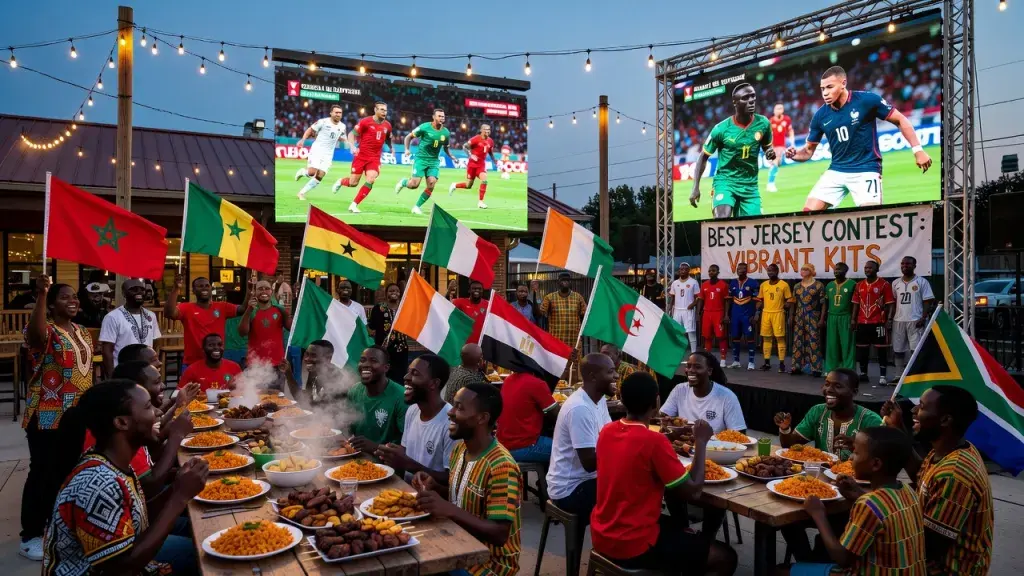
In the Atlanta suburb of Norcross and nearby Marietta, Ike's Cafe and Grill hosted packed watch parties complete with live music, a best jersey contest, and West African cuisine. The atmosphere, by all accounts, was less about results and more about recognition. "Even if you're not from Senegal or any other African team there, we're just happy to see how far we can get," said Marcy Kwarteng, the Ghanaian co-owner of Ike's. "It's a beautiful thing to see that we can unite as a continent and push each other forward and do so on such a grand scale." Her words carried the weight of a community long accustomed to watching the world's stage from the margins.
A Record Presence, a Renewed Pride
For Nigerian chef Okon James of Iman West African Cuisine in Norcross, the scale of this year's African participation triggers memories of the 1996 Atlanta Olympics - an event he witnessed firsthand after immigrating to the United States in 1984. "People were happy, and there were parties everywhere," he recalled. "This is the first time we've had 10 African countries participating in the World Cup, usually we only have three or two. It's very exciting to see." That numerical leap is not trivial. It reflects years of CAF lobbying, FIFA's expansion of the tournament to 48 teams, and the growing political will to elevate African football infrastructure.
Not every member of the diaspora, however, could celebrate without reservation. Charles Echemuna, who came to the United States from Nigeria at the age of six, acknowledged the broader significance while nursing a personal disappointment. "There's going to be all kinds of ethnicities and people from everywhere enjoying the game, but because Nigeria is not part of the Cup, it didn't seem as exciting," he said. His ambivalence is a familiar tension in African football fandom - pride in the continent, frustration at the national level. Nigeria's failure to qualify, despite fielding some of West Africa's finest talents, remains a sore point that speaks to deeper structural issues in the Super Eagles' setup.
Football as a Force for Political and Social Change
Beyond the spectacle, James sees the tournament as a potential catalyst for systemic reform back home. "I believe back home our leaders will sit down and assess what is happening in this World Cup and come up with something important, something different," he said. "Maybe they can set up a governing body that says soccer is to be treated as important, because at the world stage people are celebrating it." It is an argument made by football advocates across the continent for decades - that investment in football infrastructure pays dividends not just in silverware but in national cohesion, youth development, and economic growth.
France ultimately defeated Senegal 3-1, but the match carried symbolic weight that outlasted the scoreline. Mbappé, whose father was born in Cameroon, became the leading scorer in French international history - a milestone that African fans across Atlanta acknowledged with a complicated but genuine appreciation. Meanwhile, Godfred Amponsah, a Ghanaian resident of Atlanta, offered perhaps the most succinct summary of what the World Cup means to a community that spans dozens of nations and stories. "Soccer is medicine," he said. With 10 African nations on the pitch and a continent watching as one, it is difficult to argue otherwise.