
Ronaldo Chases World Cup Glory at 41 as Portugal Target 2026 Triumph
Authored by findgamesonline.com, 17-06-2026
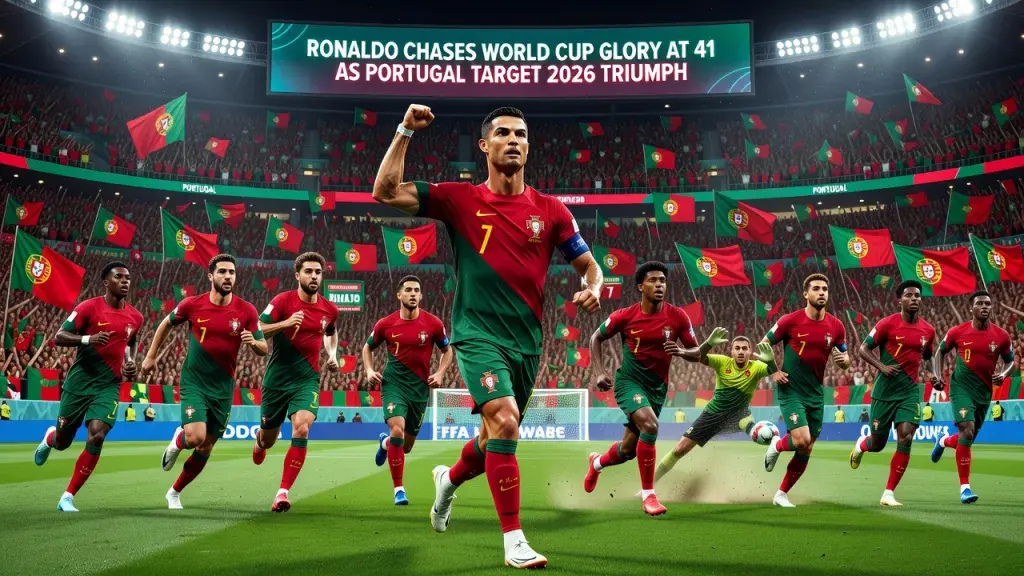
Cristiano Ronaldo arrives at the FIFA World Cup 2026 with a singular, consuming ambition: to win the one major trophy that has always stayed just out of reach. At 41, the five-time Ballon d'Or winner captains a Portugal squad that carries genuine weight as one of the tournament's leading contenders, beginning their campaign against DR Congo on June 17. For Ronaldo, this is almost certainly the last chance - and he has stated as much himself, calling the 2026 edition "a new chapter."
The narrative around his World Cup record demands context. Ronaldo has appeared at every tournament since 2006, yet his goal return across those campaigns has been uneven - eight goals in total heading into 2026, with the standout moment being his hat-trick against Spain in the 2018 group stage. That hat-trick aside, he had never scored more than once at a single World Cup, a statistic that sits oddly against a career of otherwise relentless production. That tension, between the grandeur of the individual and the modest collective returns at football's biggest stage, is what has defined his World Cup story. Fans who follow niche sports closely - from football right through to those who engage in betting on bandy - understand that even the most decorated careers can carry one conspicuous blank space, and for Ronaldo, this is his. Portugal have reached the World Cup semi-finals just twice, in 1966 and 2006, and matching that run would represent real progress for a generation of players arguably more talented than either of those predecessors.
Fitness questions hung over Ronaldo ahead of the finals after he missed Portugal's first two internationals of 2026 with a hamstring problem. He returned to start both warm-up fixtures, completing 45 minutes against Chile and 65 against Nigeria. Head coach Roberto Martinez has spoken warmly of Ronaldo's continued importance to the group, though he has also signalled he may manage his captain's minutes carefully - a precedent established by Fernando Santos at Qatar 2022, where Ronaldo was dropped to the bench for the knockout rounds. Portugal had started him in each of their previous 18 World Cup matches before that decision, and the debate over his role in the XI is likely to resurface the moment Portugal face any meaningful adversity in the United States, Canada and Mexico.
A Squad Built for More Than One Man
Whatever role Ronaldo ultimately plays in the knockout stages, Portugal's squad depth is the most compelling argument for their title credentials. Vitinha, Joao Neves and Nuno Mendes all won the Champions League with Paris Saint-Germain, the latter two alongside striker Goncalo Ramos. Bruno Fernandes was the Premier League's player of the season for 2025/26 with Manchester United. Bernardo Silva, one of the most intelligent midfielders of his generation, joins Real Madrid after leaving City and brings that quality with him to the squad. Joao Felix, revitalised since joining Ronaldo at Al-Nassr, adds flair and unpredictability in attack.
At the back, Ruben Dias provides the defensive leadership, with Joao Cancelo, Diogo Dalot and Nuno Mendes offering width and energy across the defensive line. Diogo Costa in goal is a noted penalty-saver, a detail that could yet prove decisive in a tournament where knockout ties regularly reach shootouts. Portugal's historical weakness has been breaking down disciplined, low-block defences, and that challenge will not disappear in 2026. But the collective quality of this squad, from midfield creation through to finishing, is arguably the deepest they have assembled in the modern era.
The Road Ahead and the Rivals in the Way
Portugal face DR Congo, Uzbekistan and Colombia in Group H and are considered strong favourites to advance. Should they top the group, they meet a third-placed side from group D, E, I, J or L in the last 32 - a favourable draw on paper. The knockout path beyond that, however, is where the serious obstacles begin. Argentina, led by Lionel Messi - Ronaldo's great generational rival - along with Spain, France, England, Brazil and Germany represent the sides Portugal are most likely to have to overcome if they are to go all the way. The prospect of a Ronaldo-Messi World Cup final is the kind of theatre the game has rarely, if ever, produced, and the weight of that possibility alone adds a layer of drama to every result either side posts.
Ronaldo's message before the tournament - "Believe it like we do" - was directed at Portuguese communities around the world. Whether it translates into a winners' medal remains to be seen. What is not in doubt is that this squad, at this moment, represents Portugal's most credible World Cup challenge in two decades. The pressure of that reality rests on the entire group, not just on its ageing, iconic captain. But make no mistake: the story of Portugal at the 2026 World Cup will be told through Ronaldo's eyes, for better or worse.
Portugal's 2026 World Cup Squad
- Goalkeepers: Diogo Costa (Porto), Jose Sa (Wolves), Rui Silva (Sporting), Ricardo Velho (Genclerbirligi)
- Defenders: Diogo Dalot (Man United), Matheus Nunes (Man City), Ruben Dias (Man City), Nelson Semedo (Fenerbahce), Joao Cancelo (Barcelona), Nuno Mendes (PSG), Goncalo Inacio (Sporting), Renato Veiga (Villarreal), Tomas Araujo (Benfica)
- Midfielders: Ruben Neves (Al-Hilal), Samu Costa (Mallorca), Joao Neves (PSG), Vitinha (PSG), Bruno Fernandes (Man United), Bernardo Silva (Man City)
- Forwards: Cristiano Ronaldo (Al-Nassr), Joao Felix (Al-Nassr), Francisco Trincao (Sporting), Francisco Conceicao (Juventus), Pedro Neto (Chelsea), Rafael Leao (Milan), Goncalo Guedes (Real Sociedad), Goncalo Ramos (PSG)